
5 Reasons why you need an in-house CKYC solution

As customer onboarding becomes quicker, more digital, and more regulated, Central KYC has evolved from a backend compliance process to a crucial capability for banks and NBFCs. CKYC now goes beyond merely meeting regulatory requirements; it directly influences onboarding speed, data governance, audit readiness, and long-term operational resilience.
Central KYC (CKYC) is a unified Know Your Customer registry managed by CERSAI under the Prevention of Money Laundering Act. All regulated financial institutions in India must search, download, and upload KYC records via this registry for new customer onboarding and updates. With over 100 crore KYC records already established, CKYC serves as the single source of truth for verified customer identity across the financial system.
Despite its critical role, many institutions still depend on third-party CKYC gateway vendors to access the CERSAI registry. While this model allows for quick implementation, it introduces structural risks that increase as institutions grow. These risks are prompting more banks and NBFCs to consider whether CKYC should remain vendor-managed or become an internally owned capability.
This shift in perspective underscores the need for an in-house CYKC solution that aligns with regulatory expectations, data governance principles, and institutional control.
The Reality of Vendor-Led CKYC Solution Implementations
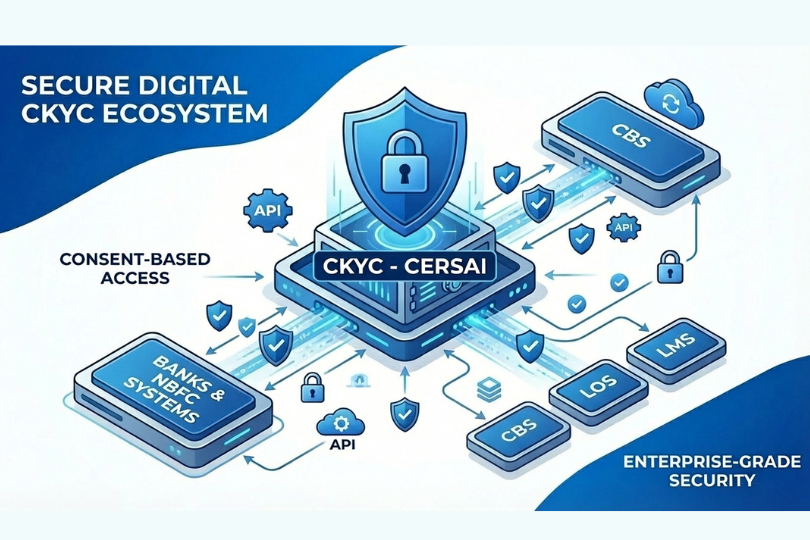
Most CKYC gateway vendors act as intermediaries between financial institutions and CERSAI. Internal systems like core banking, loan origination, loan management, and card platforms connect to the vendor, which then links to the CKYC registry.
Initially, this approach seems efficient. Institutions avoid direct integration complexity and rely on vendors for upgrades and regulatory changes. However, over time, several structural challenges arise. What begins as convenience gradually becomes dependency.
Understanding these challenges is crucial to appreciating why an in-house CYKC solution is becoming more relevant.
Reason 1: Data Sovereignty Becomes a Governance Risk
When KYC data leaves your infrastructure, control leaves with it.
KYC data contains highly sensitive personal and identity information. When CKYC operations are handled by a third-party vendor, this data is processed or stored outside the institution’s direct control. Even if the vendor follows security best practices, the responsibility for data protection remains entirely with the institution.

This raises serious data sovereignty concerns. Regulators increasingly expect banks and NBFCs to demonstrate where customer data resides, who accesses it, and how it is protected. When data flows through vendor infrastructure, institutions often struggle to provide clear, defensible answers during audits.
An in-house CYKC solution mitigates this risk by ensuring complete control over identity data. All CKYC operations occur within the institution’s own environment, significantly reducing exposure and strengthening compliance posture.
Reason 2: Intermediary Dependency Limits Operational Control
Relying on intermediaries for CKYC access turns a regulatory necessity into a single point of failure
Vendor-led CKYC models create an unavoidable dependency. Institutions do not access CERSAI directly. Every search, download, upload, or update must pass through the vendor’s systems.

This dependency introduces multiple issues. Any outage, latency, or error on the vendor side directly impacts customer onboarding. Long contract lock-in periods make it difficult to move away, even if service quality declines or compliance expectations change.
More importantly, institutions lose visibility into how CKYC operations are executed, logged, and audited. From a risk management perspective, outsourcing this level of control over a regulatory process is increasingly hard to justify.
Owning an in-house CYKC solution removes this dependency and restores institutional autonomy. It allows banks and NBFCs to interact directly with CERSAI and manage CKYC as a core internal function.
Reason 3: Per-Transaction Pricing Fails at Scale
A pay‑per‑KYC model quietly penalizes growth and makes compliance increasingly expensive
Most CKYC gateway vendors use a pay-per-transaction model. Every KYC search, download, or upload incurs a fee. While this may seem affordable at low volumes, it becomes a significant cost burden as onboarding scales.

For institutions onboarding large numbers of customers across multiple product lines, CKYC costs can quickly escalate. The more the institution grows, the more it pays. This creates a misalignment between growth and cost efficiency.
An in-house CYKC solution changes this equation. Instead of variable costs tied to transaction volumes, institutions invest in a fixed platform that scales with their business. This makes CKYC economically sustainable over the long term.
Reason 4: Fragmented KYC Data Weakens Audit Readiness
Disparate KYC integrations create data silos that surface as audit failures
Vendor-based CKYC implementations often lead to fragmented KYC data across internal systems. Different product teams integrate in different ways, resulting in duplicated records, mismatched updates, and multiple KYC versions across CBS, LOS, LMS, and card systems.

These inconsistencies typically surface during audits. Regulators do not assess vendors. They assess institutions. When KYC data does not match across systems, it creates audit findings even if the root cause lies in a fragmented architecture.
A centralised in-house CYKC solution acts as a single orchestration layer. It ensures that verified KYC data is consistently distributed across all internal systems, significantly reducing reconciliation effort and audit risk.
Reason 5: CKYCRR 2.0 Raises the Bar on Accountability
CKYCRR 2.0 demands institutional ownership, not abstracted vendor compliance
The CKYCRR 2.0 upgrade has transformed how institutions must integrate with CERSAI. Legacy file-based submissions are being replaced with API-driven, real-time interactions. Mandatory requirements now include Digital Signature Certificate authentication, OTP-based customer consent, Aadhaar masking, audit trails, and strict data localisation.

For institutions dependent on vendors, this upgrade introduces uncertainty. Compliance timelines, implementation quality, and audit readiness all depend on third-party execution. Institutions often lack direct visibility into whether these requirements are fully met.
An in-house CYKC solution allows institutions to embed CKYCRR 2.0 requirements directly into their systems. Compliance becomes demonstrable through internal controls rather than assumed through vendor assurances.
Rethinking CKYC as a Core Capability
As CKYC matures, regulators increasingly expect institutions to treat identity governance as a first-class responsibility. CKYC is no longer just a plumbing function. It sits at the intersection of compliance, technology, customer experience, and risk management.
This shift is prompting banks and NBFCs to re-evaluate their CKYC architecture. The question is no longer whether CKYC should work, but whether the institution truly controls it.
This is where modern, institution-owned CKYC platforms begin to play a role.
Where SimTrust Fits into the Picture
SimTrust emerges as a natural response to the limitations of vendor-led CKYC models. It is designed as a bank-owned CKYC gateway that enables institutions to move from dependency to ownership without compromising on regulatory compliance.
Rather than acting as an intermediary, SimTrust enables direct connectivity to CERSAI’s CKYCRR 2.0 APIs using the institution’s own Digital Signature Certificate. All CKYC operations such as search, download, upload, and update are executed entirely within the institution’s infrastructure.
Verified KYC data is then distributed across internal systems including CBS, LOS, LMS, and cards, through a unified integration hub. At no point does customer data pass through external vendor servers. Customers never interact with SimSol infrastructure, and CKYC traffic never traverses SimSol’s network.
SimTrust does not replace institutional control. It reinforces it.
From Vendor Dependency to Institutional Ownership
By adopting a platform like SimTrust, institutions transition from leasing CKYC access to owning it. They eliminate data sovereignty risks, remove intermediary dependencies, control costs, unify KYC data, and simplify regulatory compliance.
More importantly, CKYC becomes a strategic internal capability rather than an outsourced service. This aligns closely with evolving regulatory expectations and long-term digital transformation goals.
Final Thoughts
Vendor-led CKYC gateways solved an early adoption problem, but they are increasingly misaligned with the scale, governance, and accountability demands of today’s financial institutions. Data risk, dependency, cost escalation, fragmentation, and compliance uncertainty are no longer acceptable trade-offs.
An in-house CYKC solution offers a path forward. It restores control, improves resilience, and positions institutions to handle future regulatory changes with confidence.
For banks and NBFCs serious about owning their compliance infrastructure, solutions like SimTrust represent a shift from convenience-driven decisions to governance-first architecture. And in today’s regulatory environment, that shift is not just prudent. It is inevitable.
FAQ
What is CKYC and why is it important for banks and NBFCs?
CKYC is a centralized KYC registry managed by CERSAI that allows banks and NBFCs to use a single, verified customer KYC record across products. It reduces onboarding time, lowers operational costs, and ensures RBI-compliant customer verification.
Why is CKYC mandatory for banks and NBFCs in India?
RBI mandates CKYC under the PMLA and Master Direction on KYC. Banks and NBFCs must search, download, and upload KYC records through CERSAI to ensure standardized identity verification and prevent money laundering risks.
What challenges do banks face with traditional CKYC integrations?
Most banks rely on third-party vendors for CKYC access, leading to limited visibility, higher data exposure risk, fragmented integrations, and audit complexity. This makes governance and compliance harder to manage at scale.
What is SimTrust CKYC Gateway?
SimTrust is a bank-owned CKYC Gateway that enables direct integration with CERSAI’s CKYCRR 2.0 APIs. It allows banks and NBFCs to perform all CKYC operations within their own infrastructure without third-party data access.
How does SimTrust help banks own their CKYC capability?
SimTrust is deployed on the institution’s servers and uses the bank’s Digital Signature Certificate for all CKYC operations. This ensures full control over data, consent, audit logs, and regulatory compliance.
How does SimTrust improve CKYC compliance and audit readiness?
SimTrust automatically logs every CKYC action including search, download, upload, and update with user identity and timestamps. This creates a complete audit trail aligned with RBI and CERSAI requirements.
Is SimTrust compliant with CKYCRR 2.0 requirements?
Yes. SimTrust supports direct REST API integration, DSC-based authentication, OTP-based consent for downloads, Aadhaar masking, data localisation, and detailed audit logging as mandated under CKYCRR 2.0.
How does SimTrust integrate with bank and NBFC systems?
SimTrust acts as a central CKYC hub that connects with CBS, LOS, LMS, cards, and other internal systems. Verified KYC data is distributed securely across systems from a single source.
Does customer KYC data pass through SimTrust or SimSol servers?
No. All CKYC operations and data processing happen entirely within the institution’s infrastructure. Customer data never traverses SimSol’s network and no third-party middleware is involved.
Why should banks and NBFCs choose SimTrust over vendor-led CKYC models?
SimTrust eliminates vendor dependency, reduces data risk, improves regulatory control, and enables banks to treat CKYC as a core internal capability rather than a leased compliance service

Comments