
Transforming CKYC: The Future of Customer Identity Verification

Updated: Sep 21
The Changing Face of CKYC in India: CKYC Gateway Solution
Central KYC is a unified Know Your Customer registry managed by CERSAI under the Prevention of Money Laundering Act. Every regulated financial institution in India must search, download, and upload KYC records through this registry for new customer onboarding and periodic updates. With over 100 crore records already created, CKYC has become core financial infrastructure rather than a supporting system.
Traditionally, most institutions accessed CKYC through third-party gateway vendors. These vendors acted as intermediaries between institutional systems and CERSAI, providing quick onboarding and ready-made integrations. While this model facilitated adoption, it also concealed deeper risks related to data control, dependency, and cost at scale. The introduction of CKYCRR 2.0 and the tightening of RBI expectations have highlighted these issues. Institutions must decide whether to continue outsourcing such a critical function or assume ownership of it.
Why the CKYC Gateway Market is at an Inflection Point
Three forces are reshaping the CKYC technology landscape.
First, CKYCRR 2.0 has replaced legacy file-based integrations with real-time, API-driven interactions. This change requires Digital Signature Certificate-based authentication, OTP-based customer consent, Aadhaar masking, detailed audit trails, and strict data localization.
Second, the RBI has heightened governance expectations regarding customer data. Institutions are increasingly expected to demonstrate direct control over identity flows, audit logs, and compliance controls rather than relying solely on vendor assurances.
Third, banks and NBFCs are scaling faster than ever. Digital lending, instant account opening, and multi-product relationships have driven onboarding volumes to levels where vendor cost models and architectural limitations are unsustainable.
In this environment, the market is no longer seeking another intermediary platform. It is looking for a CKYC Gateway Solution that aligns with institutional ownership, regulatory accountability, and future growth.
Reason 1: Bank-Owned Deployment With Zero Intermediary Dependency
Most CKYC gateways in the market operate as intermediary SaaS platforms. Customer KYC data flows through vendor infrastructure before reaching CERSAI or returning to the institution. This setup introduces data sovereignty risks and creates structural dependency on a third party for a regulatory function.
SimTrust offers a fundamentally different approach. It is deployed within the institution’s own infrastructure and uses the institution’s Digital Signature Certificate to connect directly to CERSAI’s CKYCRR 2.0 APIs. There is no intermediary layer. SimSol is never an intermediary between the institution and the registry.
This ensures that customer KYC data remains under institutional control and that every CKYC operation is executed and governed internally. From a regulatory and risk perspective, this design eliminates one of the most challenging audit questions: who truly controls customer identity data.
This level of ownership differentiates SimTrust as a CKYC Gateway Solution for institutions prioritizing accountability over convenience.

Data Control as a Strategic Advantage
Data sovereignty is no longer just a security concern; it is a governance requirement. When KYC data is processed on third-party servers, institutions remain accountable for breaches, misuse, and compliance failures even if the vendor is at fault.
By ensuring all CKYC operations occur entirely within institutional infrastructure, SimTrust enables banks and NBFCs to confidently meet data localization requirements. Audit responses are based on system-level evidence rather than vendor contractual claims.
As regulatory scrutiny intensifies, this architecture shifts CKYC from a potential liability to a controlled, auditable internal capability.
Reason 2: Unified Integration Layer for All Banking Systems
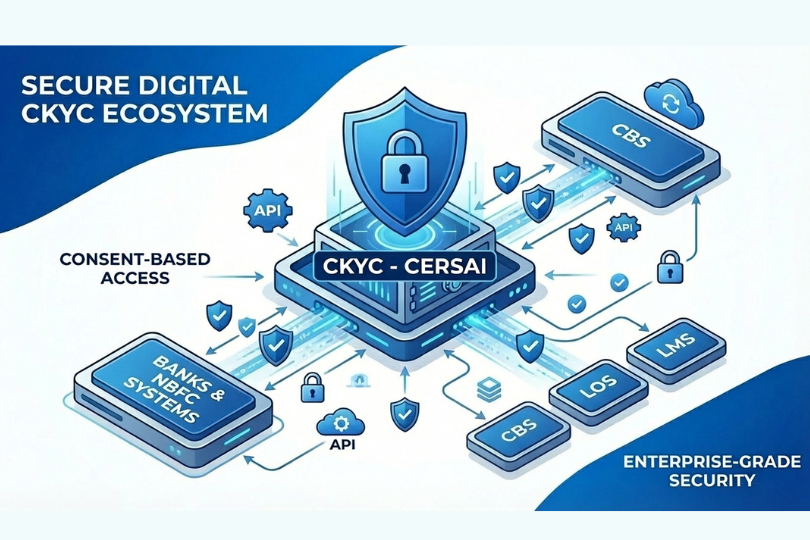
One of the most persistent challenges with vendor-led CKYC gateways is fragmentation. Different product teams often integrate separately with the vendor, leading to duplicated logic, inconsistent data flows, and multiple versions of the same KYC record across CBS, LOS, LMS, card platforms, and insurance systems.
These inconsistencies frequently surface during regulatory audits. Although the root cause may lie in fragmented architecture, the accountability always rests with the institution.
SimTrust addresses this problem by acting as a single integration hub for all internal systems. It provides one controlled entry and exit point for the complete CKYC lifecycle, including search, download, upload, verification, and ongoing monitoring.

As a centralized CKYC Gateway Solution, SimTrust ensures that verified KYC data is consistently distributed across all systems, eliminating silos and improving audit readiness.
Complete CKYC Lifecycle Management
SimTrust is designed to manage the complete CKYC lifecycle. Real-time search enables instant identification of existing records. Upload and registration ensure new customers are created correctly. Secure downloads retrieve verified KYC with consent. Ongoing monitoring and updates ensure data remains current across product lines.
This full-lifecycle capability removes the need for multiple point integrations and reduces operational complexity. Technology teams benefit from simpler architecture. Compliance teams benefit from consistent data. Business teams benefit from faster onboarding and fewer exceptions.
Reason 3: Built-In Compliance That Scales With Regulation
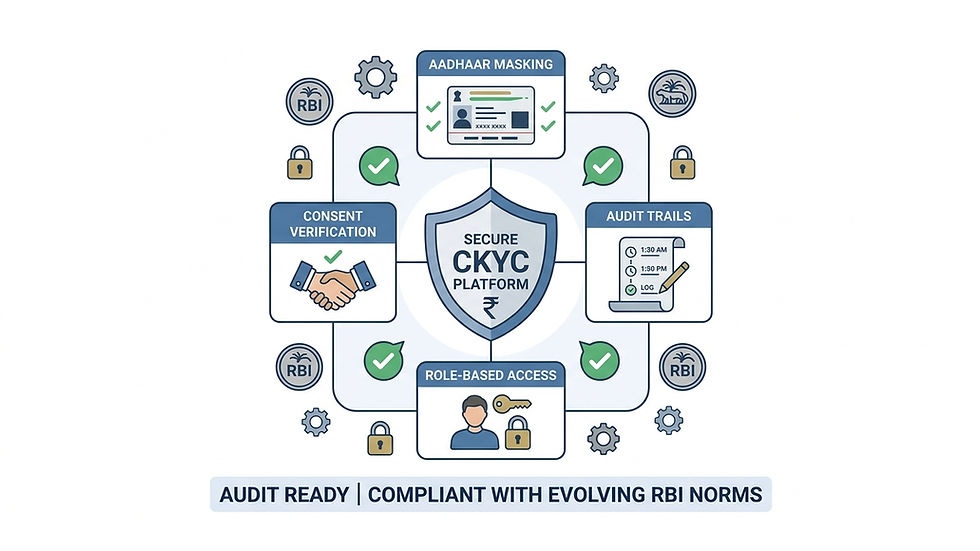
CKYCRR 2.0 has raised the technical and governance bar for CKYC integration. Compliance now requires more than connectivity; it requires demonstrable controls for consent, masking, access management, and audit logging.
SimTrust embeds these requirements directly into the platform. Aadhaar masking is enforced by design. Role-based access control governs who can initiate and approve CKYC actions. Every operation is logged with user identity, timestamp, and outcome to create a comprehensive audit trail.
This approach transforms compliance from an external dependency into an internal control system. Institutions no longer rely solely on vendor certifications. They can demonstrate adherence through their own systems and logs.
This makes SimTrust not just compliant today, but adaptable as regulations evolve. That adaptability is a defining feature of a modern CKYC Gateway Solution.
Security That Goes Beyond Checklists: CKYC Gateway Solution
Security in CKYC is not optional. SimTrust CKYC Gateway is independently security certified and built with enterprise-grade controls. Its production-ready architecture includes a robust backend and a clean, intuitive dashboard that allows teams to monitor operations without exposing data to unnecessary risk.
By maintaining all execution internally and enforcing least-privilege access, SimTrust aligns with RBI expectations around defense in depth and operational transparency.
Designed for the Full Spectrum of Regulated Institutions
SimTrust is designed for scheduled commercial banks, NBFCs, co-operative banks, MFIs, insurance companies, and stockbrokers. Its flexible deployment model allows institutions of varying sizes and onboarding volumes to adopt it without over-engineering.
Whether an institution processes thousands or millions of CKYC transactions, SimTrust scales without introducing variable per-transaction vendor fees. This right-sized approach is especially relevant for NBFCs and regional banks that need enterprise-grade compliance without enterprise-only cost structures.
This scalability reinforces SimTrust’s position as a future-ready CKYC Gateway Solution.
Long-Term Cost Efficiency Without Transaction Traps
Vendor-led CKYC models often rely on per-transaction pricing. As onboarding scales, costs increase linearly with customer volume. Over time, CKYC becomes an ongoing operational expense rather than a fixed infrastructure investment.
SimTrust breaks this pattern. By enabling institutions to own the platform, it shifts CKYC economics toward predictable, long-term efficiency. Growth is no longer penalized by rising gateway fees.
This economic alignment is critical in a landscape where digital onboarding is only accelerating.
Why SimTrust Is Uniquely Positioned in the Indian Market
SimTrust is the only solution in the Indian market that combines bank-owned deployment, direct CERSAI connectivity, and multi-system integration in a single product. It reflects SimSol’s deep banking domain expertise and understanding of regulatory realities rather than theoretical compliance.
The CKYC solution market is at a clear turning point. Institutions now recognize the risks embedded in intermediary SaaS models. Regulators demand greater accountability. Technology teams seek simpler, more governable architectures.
In this context, SimTrust stands out as a CKYC Gateway Solution built around ownership, not abstraction.
From Vendor Reliance to Institutional Independence
Adopting SimTrust is not just a technology decision; it is a strategic shift. Institutions move from reliance on vendors for regulatory access to direct ownership of a core compliance function.
This shift strengthens governance, simplifies audits, reduces cost uncertainty, and aligns CKYC with long-term digital transformation goals. It also sends a clear signal to regulators that the institution treats customer identity as a controlled internal responsibility.
Final Thoughts: CKYC Gateway Solution
CKYC has become too important to be treated as a black-box service. As regulatory expectations tighten and onboarding volumes scale, institutions need to rethink how they access and govern the registry.
A modern CKYC Gateway Solution must deliver more than connectivity. It must deliver control, security, compliance, and scalability. SimTrust achieves this by removing intermediaries, unifying systems, and embedding compliance directly into institutional infrastructure.
For banks and NBFCs looking to future-proof their CKYC architecture, SimTrust is not just an alternative. It is the logical next step in the evolution of CKYC governance.
FAQ
What is CKYC and why is it important for banks and NBFCs?
CKYC is a centralized KYC registry managed by CERSAI that allows banks and NBFCs to use a single, verified customer KYC record across products. It reduces onboarding time, lowers operational costs, and ensures RBI-compliant customer verification.
Why is CKYC mandatory for banks and NBFCs in India?
RBI mandates CKYC under the PMLA and Master Direction on KYC. Banks and NBFCs must search, download, and upload KYC records through CERSAI to ensure standardized identity verification and prevent money laundering risks.
What challenges do banks face with traditional CKYC integrations?
Most banks rely on third-party vendors for CKYC access, leading to limited visibility, higher data exposure risk, fragmented integrations, and audit complexity. This makes governance and compliance harder to manage at scale.
What is SimTrust CKYC Gateway?
SimTrust is a bank-owned CKYC Gateway that enables direct integration with CERSAI’s CKYCRR 2.0 APIs. It allows banks and NBFCs to perform all CKYC operations within their own infrastructure without third-party data access.
How does SimTrust help banks own their CKYC capability?
SimTrust is deployed on the institution’s servers and uses the bank’s Digital Signature Certificate for all CKYC operations. This ensures full control over data, consent, audit logs, and regulatory compliance.
How does SimTrust improve CKYC compliance and audit readiness?
SimTrust automatically logs every CKYC action including search, download, upload, and update with user identity and timestamps. This creates a complete audit trail aligned with RBI and CERSAI requirements.
Is SimTrust compliant with CKYCRR 2.0 requirements?
Yes. SimTrust supports direct REST API integration, DSC-based authentication, OTP-based consent for downloads, Aadhaar masking, data localisation, and detailed audit logging as mandated under CKYCRR 2.0.
How does SimTrust integrate with bank and NBFC systems?
SimTrust acts as a central CKYC hub that connects with CBS, LOS, LMS, cards, and other internal systems. Verified KYC data is distributed securely across systems from a single source.
Does customer KYC data pass through SimTrust or SimSol servers?
No. All CKYC operations and data processing happen entirely within the institution’s infrastructure. Customer data never traverses SimSol’s network and no third-party middleware is involved.
Why should banks and NBFCs choose SimTrust over vendor-led CKYC models?
SimTrust eliminates vendor dependency, reduces data risk, improves regulatory control, and enables banks to treat CKYC as a core internal capability rather than a leased compliance service.
Also Read:
Follow us on:


Comments