
CKYC Compliance Management: Updates, Exceptions and Audit Trails

CKYC compliance management is an ongoing process involving the submission of required records, furnishing changes to CKYCR, acting on registry notifications, and maintaining retrievable supporting evidence. Creating an initial record is just one part of the lifecycle. Changes such as address updates, submission rejections, or CKYCR notifications about updated records create operational tasks that must be assigned, completed, and recorded.
Why CKYC compliance management is a lifecycle process
Imagine an NBFC that records a customer's KYC information at the start of a loan relationship. If the customer later updates their KYC details, the NBFC must identify which records and systems require updating and carry out the necessary CKYCR process.
If a submission or update is rejected, the task isn't complete just because a file or API request was made. The institution must obtain the response, understand the reason for the failure, and have a documented follow-up.
The RBI Master Direction on KYC requires applicable KYC records to be uploaded to CKYCR within 10 days of commencing an account-based relationship. The RBI’s November 2024 amendment further states that when an RE obtains additional or updated information in the circumstances covered by the rule, it must furnish that updated information to CKYCR within seven days, or within another period notified by the Central Government.
Track the distinction between submission and completion
CKYC compliance management begins with an accurate transaction state. A practical workflow identifies events like created internally, ready for validation, submitted, response received, rejected, pending follow-up, and completed after correction.
While status labels may vary by system, the goal is to avoid mistaking a sent request for a completed obligation.
This distinction helps answer key questions: Was a record uploaded on time? Did the registry accept it? If the request failed, who is responsible?
4 events that need a clear operating procedure
1. A customer changes KYC information
The institution verifies the change according to its procedures, records it in the primary system, determines if the update should be sent to CKYCR, submits the data, and tracks the result.
When multiple systems hold customer information, updating CKYCR alone won't fix local discrepancies. CBS, LOS, and LMS records may need coordinated updates and reconciliation. Define the owner of each action instead of assuming a gateway will update every application without configuration.
2. CKYCR notifies the institution that a record has been updated
The RBI KYC amendment states that CKYCR will electronically inform reporting entities that have dealt with the customer when the KYC record is updated. Once an RE receives such an update notification, it must retrieve the updated KYC record and update the KYC record it maintains.
Operationally, that notification needs to enter a monitored process. A useful CKYC compliance management dashboard can show when the notification arrived, whether the record was retrieved, whether internal records were updated and whether any exception remains open.
3. A submission fails validation
Failures may involve missing mandatory information, data-format issues or values that do not meet the registry’s accepted structure. The CKYCR user manual documents rejected records, response files, probable-match reconciliation and update notifications, all of which underline the need to treat registry responses as part of the workflow rather than as an afterthought.
Pre-submission validation can reduce preventable errors but cannot guarantee acceptance. Review a sample of rejected cases to identify recurrent upstream problems, such as an incorrect field mapping or missing source-system data.
4. A case reaches its escalation threshold
Daily monitoring should identify ageing cases and applicable action dates. Operational teams can investigate pending transactions while compliance teams oversee policy, escalation and evidence. The institution should define which events require immediate review and which can be handled through the normal queue.
If an event also constitutes a technology or cyber-security incident, follow the incident-reporting requirements actually applicable to that event and institution. Avoid treating a single reporting timeline as universal across every regulator and incident type.
What should a CKYC audit trail contain?
An audit trail should let an authorised reviewer reconstruct the event without exposing more personal information than necessary. Depending on the workflow, useful records include a transaction or correlation ID, originating application, responsible user or service, action type, timestamps, consent evidence where required, registry response, status changes and resolution notes.
Logs should be protected against inappropriate modification and subject to approved access and retention rules. They should not contain credentials, raw OTPs or unnecessary document data. The registry’s user manual includes access trails, MIS reports, update notifications and logs as operational functions. For a broader performance framework, see 5 Metrics to Measure CKYC Software Success.
Where a compliance cockpit adds value
A useful cockpit does not merely count downloads. It separates registrations, updates, open exceptions, unresolved notifications and approaching action dates. Filters by branch, product and owner can help teams identify workload and recurring issues.
No dashboard removes the institution’s governance responsibility. Under the RBI IT outsourcing directions, outsourcing does not diminish an RE’s obligations or the responsibility of its Board and Senior Management. Technology can support CKYC compliance management, but accountability remains with the institution.
How SimTrust supports CKYC compliance management
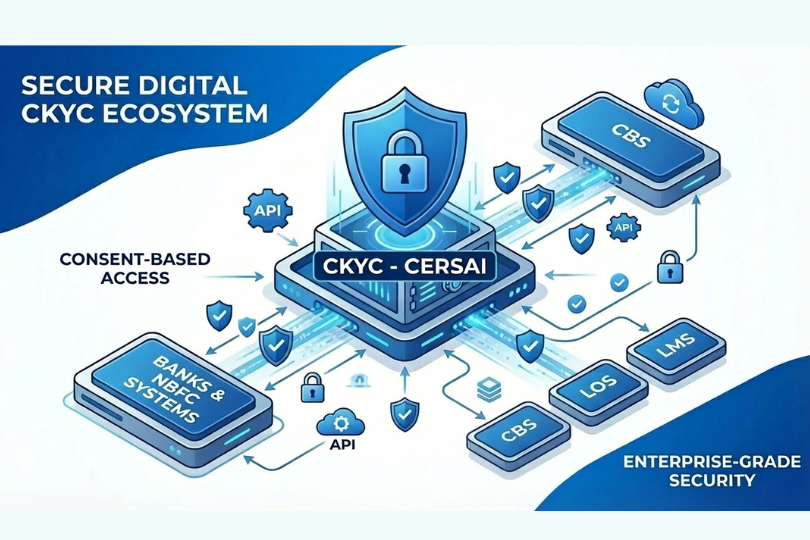
SimTrust CKYC Gateway is a software platform, designed to provide a central integration layer between an institution’s internal applications and CERSAI. The gateway supports CKYC search, consent-based download, upload and update workflows and can connect with systems such as CBS, LOS and LMS.
The platform is also designed to support built-in validation, transaction monitoring, exception reporting and audit trails. For institutions operating several customer-facing or lending systems, a central gateway can reduce the need to build and maintain separate CKYC integrations for each application.
SimTrust CKYC gateway can support an institution’s operational and compliance processes, but it does not by itself make an institution compliant. The regulated entity remains responsible for following RBI requirements, CERSAI instructions and its own governance and security obligations.
To learn more about the solution capabilities, deployment and integration options, explore SimTrust CKYC Gateway and request a demo.
FAQ (Frequently Asked Questions) about CKYCRR 2.0
Is a CKYC record complete once an upload request is sent?
No. Operations teams should confirm the outcome and resolve any rejection or pending response rather than treating transmission as acceptance.
What happens when CKYCR notifies an institution of an updated record?
Under the RBI KYC framework, the RE must retrieve the updated KYC record from CKYCR and update the KYC record it maintains.
Does every customer-data change require the same CKYC amendment?
No. Determine what information changed and apply the relevant regulatory rules, CKYCR procedures and institutional controls. Avoid a one-size-fits-all workflow.
What is the purpose of a CKYC exception report?
It gives operations teams a controlled view of cases that require investigation or action, such as rejected submissions, unresolved responses, mismatches and ageing updates.
Can a gateway guarantee compliance?
No. It can support validation, tracking and evidence, but institutions remain responsible for due diligence, correct information, timely action and oversight.

Comments