
One CKYC Gateway, Multiple Banking Systems: Simplifying Integration with CERSAI

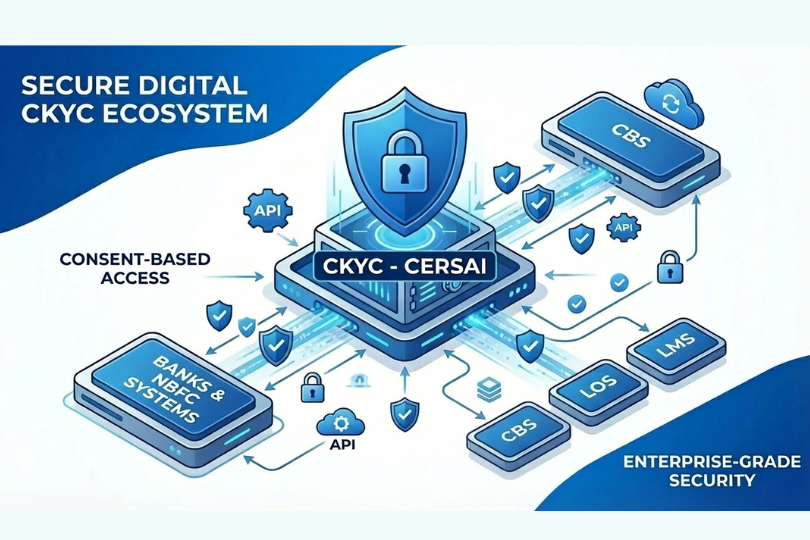
CKYC gateway software connects an institution’s banking applications to a central layer that handles communication with CERSAI. Instead of giving each application its own registry-facing workflow, the institution can route permitted CKYC requests through a common service and return outcomes to the systems that need them.
For banks and NBFCs using several core and lending platforms, the practical question is: How can CKYC workflows stay consistent as products, channels, and applications change?
Why does CKYC gateway integration matter?
If a bank or NBFC uses a core banking system (CBS) for accounts, a loan origination system (LOS) for applications, a loan management system (LMS) for servicing and another platform for cards. Each may need KYC information at a different stage of the customer journey.
Separate point-to-point connections require that each team manages registry formats, authentication, response handling, and future modifications. By integrating a CKYC gateway, shared registry-facing functions are consolidated into a single layer, allowing applications to make use of predefined internal interfaces instead of independently executing the same external processes.
This design does not eliminate the need for changes at the application level. Each source system must still have a compatible interface, field mapping, security controls, and a method to handle the returned results.
A typical CKYC gateway integration journey
Step 1: The LOS starts an authorised search
The loan application captures the information needed to initiate a CKYC search. The gateway validates supported parameters and confirms that the request comes from an authorised system before communicating with the registry.
The official CKYCR user manual documents search, download, upload, update, response and reporting functions available through the registry environment. For a primer on registry records, read What is CKYC and why is it important?
Step 2: The gateway handles the registry request
The integration layer applies connection, signing, and authentication requirements, sending requests through the institution's registry access. Institutions using API search and download must configure a public key and public IP, as per CKYCR documentation, and verify the CKYCRR 2.0 technical specification before finalizing settings.
Interface and security requirements may vary between registry versions and environments, so architecture documents should distinguish between CERSAI specifications and internal security choices.
Step 3: The source application receives a usable response
The registry may provide a search result or require further action before a record is downloaded. Where a CKYC record is downloaded, the CKYCR consent notification requires reporting entities to obtain customer consent. The gateway should expose a clear transaction state rather than describing an initiated request as a completed retrieval.
Once an appropriate record is retrieved, mapped information can be returned to the LOS for use under the institution’s data-handling rules. The RBI KYC amendment also identifies circumstances in which an RE may need additional information or verification even after retrieving an existing CKYC record.
Step 4: Registration or updates follow when required
If no suitable CKYC record exists, follow the customer-due-diligence and record-registration process. Update procedures should be applied if KYC information changes, capturing the registry outcome.
It's crucial to differentiate between sending a request and receiving confirmation. Source systems and the gateway require a consistent definition of transaction completion to ensure pending or rejected cases aren't marked as closed.
5 architecture decisions to make before implementation
1. Define ownership of customer information
Determine which application owns each field and which system initiates updates. A central gateway doesn't ensure accurate data across all platforms. Regulated Entities (REs) require field mappings, reconciliation rules, and a process to resolve conflicts.
2. Separate access permissions by application and role
Apply least-privilege access, appropriate user attribution, and controls on downloaded information, as not every system or employee needs full CKYC access. The registry's user-management model with distinct roles and access controls emphasises the importance of deliberate permission design.
Where an institution outsources parts of the technology service, the RBI Master Direction on Outsourcing of Information Technology Services states that outsourcing does not diminish the regulated entity’s obligations or those of its Board and Senior Management.
3. Design for failed and delayed transactions
What happens if the registry is unavailable, a connection times out or a response cannot be processed? The gateway needs a reliable status model, logging, controlled retries and procedures for manual resolution. Retrying every failure indiscriminately can create duplicates or obscure the original problem.
4. Confirm the deployment and network model
An RE might favour on-premises or private-cloud deployment; other service models require distinct due diligence. Examine data flows, administrative access, certificate management, disaster recovery, and the ownership of keys and credentials.
5. Test the full lifecycle, not just an API handshake
A successful API connection does not establish that the customer journey works. Test search, consent and download where applicable, registration, amendments, rejected records, recovery and downstream data delivery. The CKYCR operating guidelines also document bulk upload and response-file concepts, showing why end-to-end response handling matters.
How a central gateway changes maintenance
With CKYC gateway integration, common registry-facing changes can potentially be implemented in the gateway rather than repeated inside every banking application. That can reduce duplicated engineering, provided connected applications use stable internal contracts and regression tests.
The trade-off is that the gateway becomes important shared infrastructure. It needs capacity planning, monitoring, access governance, resilience and a clear change-management process. For related architectural considerations, see 5 Reasons You Need an In-house CKYC Solution.
How SimTrust supports CKYC gateway integration
SimTrust CKYC Gateway, is a software platform, designed to provide a central integration layer between an institution’s internal applications and CERSAI. The gateway supports CKYC search, consent-based download, upload and update workflows and can connect with systems such as CBS, LOS and LMS.
The platform is also designed to support built-in validation, transaction monitoring, exception reporting and audit trails. For institutions operating several customer-facing or lending systems, a central gateway can reduce the need to build and maintain separate CKYC integrations for each application.
A CKYC gateway can support an institution’s operational and compliance processes, but it does not by itself make an institution compliant. The regulated entity remains responsible for following RBI requirements, CERSAI instructions and its own governance and security obligations.
To learn more about the solution capabilities, deployment and integration options, explore SimTrust CKYC Gateway and request a demo.
FAQ (Frequently Asked Questions) about CKYCRR 2.0
What is the difference between a CKYC gateway and CERSAI?
CERSAI operates the central registry. A CKYC gateway is software used by an institution like a Bank or NBFC to connect its own systems and workflows to the registry; it does not replace CERSAI.
Can multiple LOS or CBS applications use one gateway?
Yes, where the gateway and each application support the necessary interfaces, authorisation and mappings. Capacity and access requirements should be verified for the proposed deployment.
Does CKYC gateway integration remove all changes to internal systems?
No. Applications still need integration work, mapping, error handling and appropriate controls. The gateway centralises shared registry-facing logic.
Can a CKYC gateway help with CKYCRR 2.0 readiness?
A CKYC gateway can support integration, transaction processing, validation, monitoring and exception management. The regulated entity must still complete the applicable CERSAI onboarding and testing activities and remains responsible for its regulatory obligations.

Comments