
When Manual CKYC Processes No Longer Scale: A Guide for Banks and NBFCs

A small lender with a low volume of loan records can manage processes directly on the CERSAI portal. However, as the volume grows, staying compliant becomes challenging.
Regulated entities (REs) risk fines for non-compliance.
Assume an NBFC processes three loans daily. An authorised employee handles KYC records by searching, completing consent and authentication, retrieving information, or arranging registration if no record exists. The team checks responses and manages exceptions.
For an NBFC processing 100 loan applications daily across multiple branches, staff work across a loan origination system (LOS), customer onboarding screens, and a CKYC portal. Even simple steps require coordination due to switching between applications. An RE handling hundreds of applications across branches must track searches, downloads, registrations, updates, and failed requests across its systems.
The RBI Master Direction on KYC provides the regulatory framework for CKYCR submission and use. Applicable KYC records must be uploaded to CKYCR within 10 days of commencement of an account-based relationship. The RE must manage this obligation whether it uses a portal or an integrated gateway. The official CKYC website should be checked for current registry notices and operating material.
5 signs that CKYC process automation deserves evaluation
1. Employees repeatedly enter the same customer information
An applicant might have already provided information to the LOS, but staff may still need to input the same details into a different CKYC workflow. This re-entry is time-consuming and can lead to transcription errors. The aim of automating the CKYC process is to transfer authorized information from the source application into the appropriate CKYC workflow, ensuring proper validation and controls are in place. Pre-populating data does not replace the need to verify the underlying information. Institutions must still detect any missing, inconsistent, or outdated fields and perform the necessary customer due diligence.
2. Search and download outcomes are difficult to reconcile
A CKYC search can require follow-up before a record is used or downloaded. Staff need a process for confirming that the record belongs to the correct customer and that the applicable consent requirements are met. The CKYCR download-consent notification states that reporting entities should obtain customer consent before downloading a CKYC record.
A gateway can bring the transaction outcome back to the originating system, reducing manual transfer of response details. Identification decisions and record-use rules still require appropriate institutional controls.
3. Rejected submissions sit in individual inboxes or queues
Suppose an upload fails because a required field is missing or a value does not meet the accepted registry format. Someone must review the response, correct the issue, resubmit when appropriate and confirm completion. The CKYCR user manual documents response handling, rejected records and bulk-upload response functions, illustrating why submission status matters operationally. CKYC process automation can centralise validation and make open exceptions visible to designated teams. It should not blindly retry rejected transactions: teams need to distinguish a connectivity failure from a request that requires data correction.
4. Deadlines rely on employee memory
Registration and relevant updates have specific deadlines. While a spreadsheet or informal reminder might suffice for a few instances, managing them becomes challenging as the number increases. Teams must be aware of when a relationship began, if registration is necessary, what has been submitted, and whether the registry has accepted it. The goal is to have a case-level status and escalation process. A dashboard by itself does not fulfill the responsibility; the institution requires individuals who take action on overdue or unsuccessful cases.
5. Every new banking application needs its own process
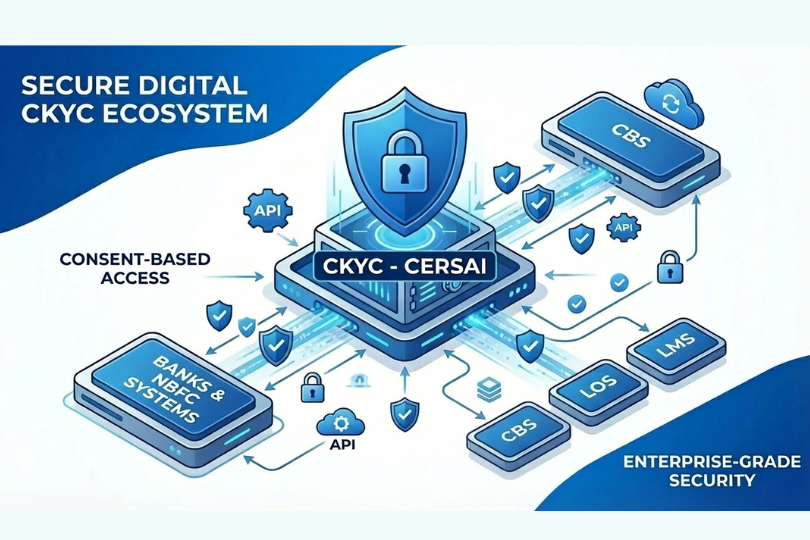
An institution might have separate loan origination systems (LOS) platforms for different lending products, a core banking system (CBS), a loan management system (LMS) and card applications. If each team builds and maintains distinct CKYC handling, changes can require multiple rounds of development and testing. CKYC process automation through a shared integration layer can consolidate common registry functions while allowing each source application to retain its own business decisions.
What should banks automate and what should remain controlled?
Suitable candidates for automation include field validation against supported masters, authorised request routing, transfer of permitted customer details, transaction-status updates, exception queues and audit-log creation. A well-designed process records not only that a request was sent but also its outcome and any necessary follow-up.
Customer consent, identity checks, exceptions requiring judgement and changes to authoritative customer data should not be treated as steps that software can bypass. Under the RBI’s November 2024 KYC amendment, an RE generally should not ask a customer to resubmit the same KYC information after retrieving a CKYC record, but further information may be required where the record has changed, is incomplete or outdated, document validity has lapsed, or additional verification or enhanced due diligence is necessary.
How to evaluate CKYC process automation
Start with a baseline: measure the time from request initiation to confirmed completion, the share of transactions requiring correction, the age of pending cases and the staff effort spent switching between systems. Segment the figures by branch, product and workflow. A fast search response alone says little about end-to-end onboarding time.
Then map your controls. Who can initiate a request? How is consent captured where required? What happens if the registry is unavailable? Can support staff see transaction status without unnecessarily accessing customer documents? How are rejected requests corrected, and is a repeated submission protected against duplication?
Finally, run a pilot using representative volumes and negative test cases. Confirm that the automated process works under ordinary conditions and that exceptions reach the right people. For ongoing measurement, see 5 Metrics to Measure CKYC Software Success.
Where SimTrust-CKYC Gateway fits
SimTrust CKYC Gateway software platform, is designed to connect an institution’s CBS, LOS, LMS and other supported applications with the CERSAI registry through a central integration layer. It supports CKYC search, retrieval, upload and updates, built-in validations, transaction logs and monitoring. The architecture is intended to reduce repeated registry-facing integrations and help operations teams follow transactions across connected applications. Product configuration, integration scope and results depend on the institution’s systems and implementation.
CKYC process automation supports operational execution; the regulated entity remains responsible for meeting its obligations. Explore the SimTrust CKYC Gateway to discuss a technical walkthrough based on your transaction volumes and system landscape.
FAQ (Frequently asked questions)
Is CKYC process automation compulsory for every NBFC?
There is no overarching requirement to buy a commercial gateway due to CKYC obligations. Institutions should select an effective approach to fulfill relevant duties and evaluate integration needs based on volume, architecture, and controls.
Can CKYC process automation eliminate customer due diligence?
No. While existing CKYC information can minimize the need for repeated documentation, further checks might still be required as outlined in the RBI KYC framework.
Does automation guarantee faster onboarding?
No. Actual turnaround depends on data quality, customer authentication, registry availability, internal approvals and exception resolution. Measure the complete journey rather than an isolated API response.
What should an operations team monitor daily?
Monitor requests awaiting completion, rejected submissions, ageing exceptions, approaching timelines, retried transactions and mismatches between registry outcomes and the originating application.
When should a small lender move away from portal-based processes?
There is no universal loan-volume threshold. Evaluate staffing, error rates, branch distribution, system fragmentation and the cost of maintaining effective controls before choosing a gateway.
Read Further
Editorial note: Regulatory status and technical specifications can change. Verify the latest CERSAI and RBI communications before publication and before making implementation decisions.


Comments